

Category: Uncategorized

Gum tree sap. The trees bleed this blood-red sap in reaction to
insect borer attacks. These insects create tunnels and chambers as they
consume the wood. The tree responds by flooding the wounded area with a
chemical called
‘kino’, but it can also be sap or amber. The kino engulfs the insect —
trapping it and hopefully killing it.
Photo credit:
Evelyn Ward de Roo
I do not trust people who don’t love themselves and yet tell me, ‘I love you.’ There is an African saying which is: Be careful when a naked person offers you a shirt.

Caterpillar of fruit piercing moth
West Bengal India
Oct 2016 by Arabinda Pal. via:
The Biologist Apprentice


Everyone thinks of changing the world, but few think of changing themselves.
Leo Tolstoy
This Never Before Seen Spider Looks Like a Leaf
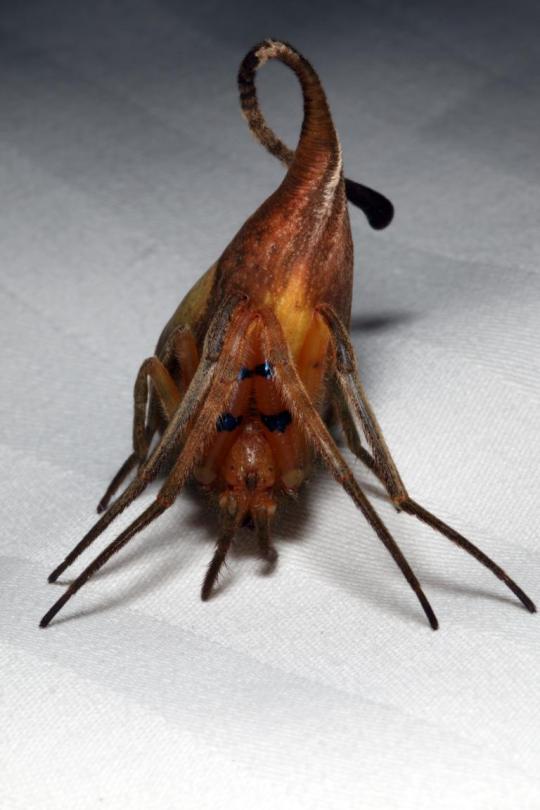
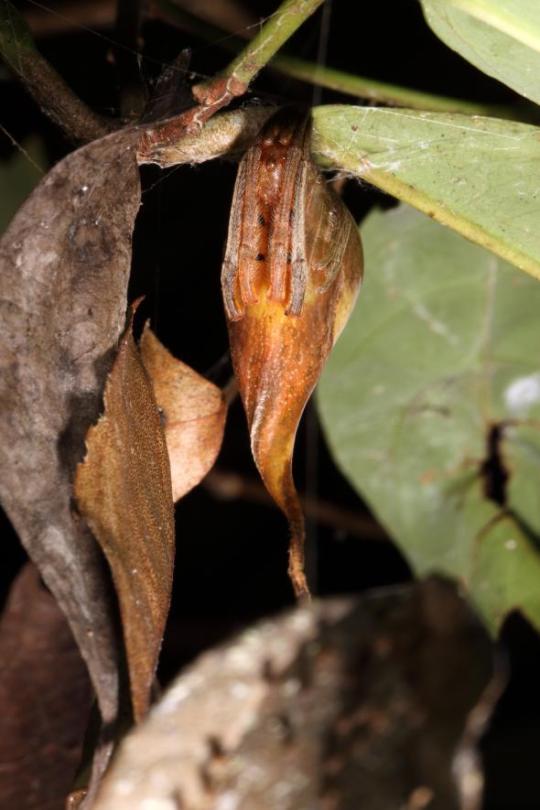
For Matjaz Kuntner, it was just another evening trek through southwestern China’s Yunnan rain forest—until his headlamp illuminated a strand of spider silk.
That’s not so surprising on its own. But what attracted the
arachnologist’s attention is the silk appeared to attach a leaf to a
tree branch. After looking closer, Kuntner realized one of these leaves
was actually a spider.
“If there’s a web, there’s a spider,” says Kuntner, of the
Smithsonian Institution and the Evolutionary Zoology Laboratory in
Slovenia.
The arachnid uses its silk to attach leaves to tree branches, and then hides among the branches, according to a new study in the Journal of Arachnology.
The researchers still aren’t sure why the spider does this, but they
believe it’s likely to hide from predators or sneak up on prey…

Honey in European Languages
Albanian – mjaltë
Basque – eztia
Belarusian – мёд
Bosnian – med
Bulgarian – мед
Catalan – mel
Croatian – med
Czech – med
Danish – honning
Dutch – honing
Estonian – mesi
Finnish – hunaja
French – miel
Galician – mel
German – Honig
Greek – μέλι
Hungarian – méz
Icelandi – chunang
Irish – mil
Italian – miele
Latvian – medus
Lithuanian – medus
Macedonian – мед
Maltese – għasel
Norwegian – honning
Polish – miód
Portuguese – mel
Romanian – miere
Russian – мед
Serbian – мед
Slovak – med
Slovenian – medu
Spanish – miel
Swedish – honung
Ukrainian – мед
Welsh – mêl
This thick golden fluid has its differentiations not only when it
comes to colour, taste and herbal origin, but even the very name of it
has numerous variations, not all of them belonging to the same language
family.
Linguists who study the Indo-European theory estimate that the
Proto-Indoeropean word for honey was melit, which gave the Sanskrit
word madhu, the Greek μέλις, the Latin mel and eventually words like μέλι(ττ)σσα or mellifluous. Hence the names mel, miel, miele, med, and all their variations.
So, what happened to the Northeners? It seems that the northern
branches of the IE language tree ( ie. the Germanic branch, unlike the
Slavs who remained loyal) followed a different path right from the
beginning. They’d name honey after the colour of it, using the PIE word
for “golden y ellow”, which is k(e)neko. That eventually evovled to the ancient Germanic huna(n)go,
which became honung in Old Norse, and then hunig in Old English. Between
Old English and now, the letter “g” following an “i” or an “e” sound
has tended to drop away or turn into a “y,” meaning that the Medieval hunig became our modern-day “honey.”
*Portuguese also includes Brazilian Portuguese , Spanish
Cental- South american spanish and french all non-frenh countries where
it’s the official language.

🐰
 סלומה
סלומה 