
via reddit.com
Tag: animal


I lost my best friend of 18 years on the 19th of November… she passed away in my bedroom at home from old age early in the morning. So many mixed emotions about it still 😦 I love you Mini ♥


This adorable Australian Shepherd is Toby
and while at first glance he may appear to look like any other
Australian Shepherd but Toby is special – he has two noses! He was
discovered wandering the streets of Fresno, California, and was picked
up by a rescue group. However, the so-called rescue group considered him
unadoptable and were ready to put him to sleep. That was until Todd
Ray, a man who owns a number of animals with birth defects, adopted him
and made him a member of his family.

Parasitic wasp larvae hatching from inside the living caterpillar host. The
female wasp will oviposit into the host’s body. The larvae will feed
inside the host until they are ready to pupate. Quite often the host is
dead by that point but if not, then the parasitoid will often eat its
way out of the host.
These wondrous sea wolves swim for miles and live off the watery wilds
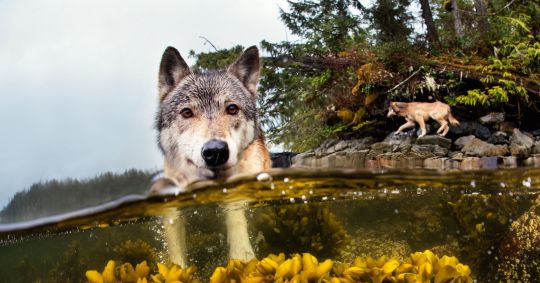
In a remote stretch of rainforest on Canada’s Pacific coast, a unique population of wolves has taken to a life of the sea.
Along the wild Pacific coast of British Columbia – a misty wonderland of
craggy glacier-gouged shores and temperate rainforest – there lives a
population of wolves genetically and behaviorally distinct from the
rest. They’ve traded in deer and sheep and mountain goats for the bounty
of the sea. They’ve been known to swim up to eight miles to get from
the mainland to an island; they live on barnacles and herring roe, seals
and dead whales. Some 90 percent of their food comes directly from the
ocean…
These wondrous sea wolves swim for miles and live off the watery wilds


Sea Bunny Nudibranch (source).
These Lizards Are Full of Green Blood That Should Kill Them
“Animal blood comes in a rainbow of hues
because of the varying chemistry of the molecules it uses to carry
oxygen. Humans use hemoglobin, whose iron content imparts a crimson
color to our red blood cells. Octopuses, lobsters, and horseshoe crabs
use hemocyanin, which has copper instead of iron, and is blue instead of
red—that’s why these creatures bleed blue. Other related molecules are
responsible for the violet blood of some marine worms, and the green
blood of leeches. But the green-blooded lizards use good old hemoglobin.
Their red blood cells are, well, red. Their green has a stranger
origin: Biliverdin.
They should be dead. Biliverdin can damage DNA, kill cells, and destroy
neurons. And yet, the lizards have the highest levels of biliverdin ever
seen in an animal. Their blood contains up to 20 times more of it than
the highest concentration ever recorded in a human—an amount that proved
to be fatal. And yet, not only are the lizards still alive, they’re not
even jaundiced. How do they tolerate the chemical? Why did they evolve
such high levels of biliverdin in the first place? And why, as Austin’s
colleague Zachary Rodriguez has just discovered, did they do so on
several occasions?”
Source: TheAtlantic


(Pseudechis porphyriacus) red-bellied black snake.
Two males engaged in combat.
 סלומה
סלומה 
