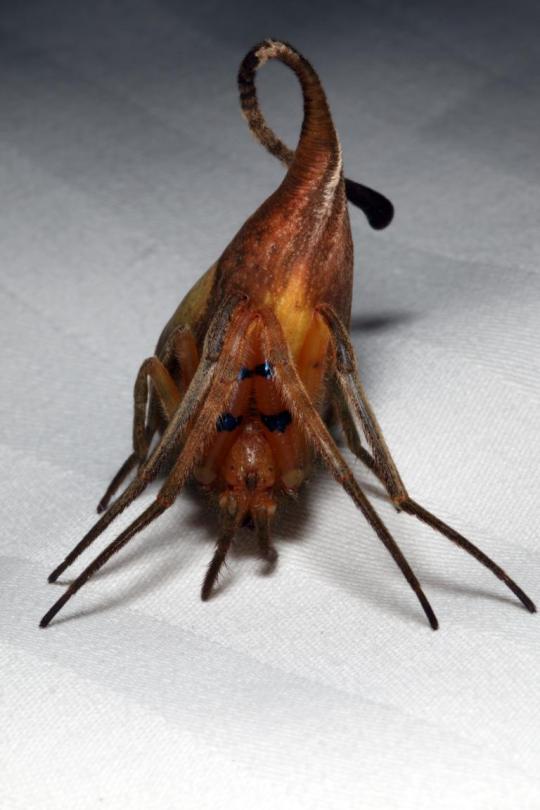
This Never Before Seen Spider Looks Like a Leaf

image

For Matjaz Kuntner, it was just another evening trek through southwestern China’s Yunnan rain forest—until his headlamp illuminated a strand of spider silk.

That’s not so surprising on its own. But what attracted the
arachnologist’s attention is the silk appeared to attach a leaf to a
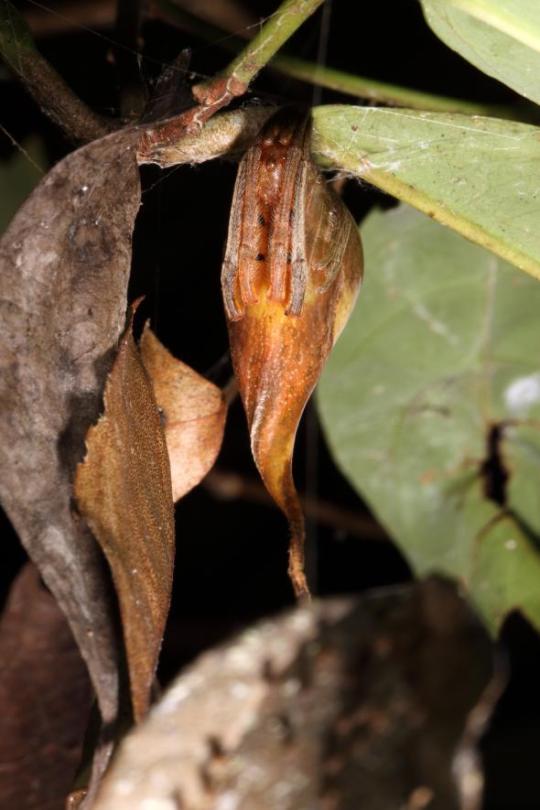
tree branch. After looking closer, Kuntner realized one of these leaves
was actually a spider.

“If there’s a web, there’s a spider,” says Kuntner, of the
Smithsonian Institution and the Evolutionary Zoology Laboratory in
Slovenia.


The arachnid uses its silk to attach leaves to tree branches, and then hides among the branches, according to a new study in the Journal of Arachnology.
The researchers still aren’t sure why the spider does this, but they
believe it’s likely to hide from predators or sneak up on prey…
image

This Never Before Seen Spider Looks Like a Leaf

In the early 1800s a man named Little Jon lived in this so called earth
cabin (swe. ‘backstuga’) located in southern Småland, Sweden. An earthen
cabin is built partially buried in the ground, in this case there’s
three walls of stone and one wall made of wood. In Sweden earthen cabins
was common in the forests from the 1600s until the late 1800s. (Link)

A mysterious, four-mile long river, deep in the heart of the Amazon,
is so hot that it boils. The river has long been a
legend in Peru, but when geoscientist Andrés Ruzo’s heard about it, he
thought such a phenomenon was impossible. Runzo discovered a four mile
‘boiling river’ in the sacred geothermal healing site of the Asháninka
people in Mayantuyacu. At
its widest, it is 82ft(25m), and around 20ft (6m)
deep. The water is hot enough to brew tea, and in some parts, it boils
over. The river boils because of fault-fed hot springs. Parts of the
river are so hot that any animals that falls in boils instantly.

Photo credit: (top & bottom) Devlin Gandy, (middle left) Sofia Ruzo, (middle right) Andrés Ruzo