

Phyllodesmium poindimiei.
Phyllodesmium poindimiei.
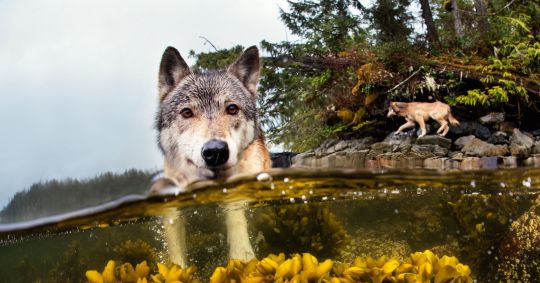
In a remote stretch of rainforest on Canada’s Pacific coast, a unique population of wolves has taken to a life of the sea.
Along the wild Pacific coast of British Columbia – a misty wonderland of
craggy glacier-gouged shores and temperate rainforest – there lives a
population of wolves genetically and behaviorally distinct from the
rest. They’ve traded in deer and sheep and mountain goats for the bounty
of the sea. They’ve been known to swim up to eight miles to get from
the mainland to an island; they live on barnacles and herring roe, seals
and dead whales. Some 90 percent of their food comes directly from the
ocean…
These wondrous sea wolves swim for miles and live off the watery wilds

Blooms in the Baltic
Every summer, phytoplankton – microscopic plant-like organisms –
spread across the North Atlantic, with blooms spanning hundreds and
sometimes thousands of miles. Nutrient-rich, cooler waters tend to
promote more growth among marine plants and phytoplankton than is found
in tropical waters. Blooms this summer off Scandinavia seem to be
particularly intense.
On July 18, 2018, the Operational Land Imager (OLI) on Landsat 8
acquired a natural-color image of a swirling green phytoplankton bloom
in the Gulf of Finland, a section of the Baltic Sea. Note how the
phytoplankton trace the edges of a vortex; it is possible that this
ocean eddy is pumping up nutrients from the depths.
Though it is impossible to know the phytoplankton type without
sampling the water, three decades of satellite observations suggest that
these green blooms are likely to be cyanobacteria (blue-green algae),
an ancient type of marine bacteria that capture and store solar energy
through photosynthesis (like plants).
In recent years, the proliferation of algae blooms in the Baltic Sea
has led to the regular appearance of “dead zones” in the basin.
Phytoplankton and cyanobacteria consume the abundant nutrients in the
Baltic ¬and deplete the oxygen. According to researchers from Finland’s
University of Turku, the dead zone this year is estimated to span about
70,000 square kilometers (27,000 square miles). Read more: https://go.nasa.gov/2uLK4aZ Make sure to follow us on Tumblr for your regular dose of space: http://nasa.tumblr.com.

Clownfish
(Amphiprion nigripes)
in sea anemone (Heteractis magnifica).


Argentinian Orca beaching itself to catch a seal pup (source).

Here, a white-spotted rose anemone clings to and attempts to ingest a
moon jelly in Monterey Bay National Marine Sanctuary. Although the
jelly is twice the size of the anemone, most of the jelly is water, so
it’s not an impossibly large meal. While moon jellies are usually open
ocean species, sometimes oceanographic conditions bring them closer to
shore – and into the mouths of creatures like this anemone. (Photo: Steve Lonhart/NOAA)

Jellyfish serve as a habitat to many ocean creatures…
Jellyfish play a critical role in the lives of different marine
creatures. While they are used as a direct food source for many, some
use them as shelter (juvenile fish), some as a means of travelling from A
to B and some have a combined interest of travelling while snacking on
the microscopic parasites attached to the Jellyfish.
These symbiotic relationships are very intricate and are being
investigated by scientists. [source]


 סלומה
סלומה 